
Hanes launches athleisure collection

Rice University engineers join global project to advance assistive smart clothing.
2nd February 2026
Knitting Industry
|
Houston, TX, USA
Smart clothing that supports movement and improves everyday mobility could arrive sooner than expected, thanks to a new multimillion-dollar international research programme backed by the Canadian government’s New Frontiers in Research Fund.
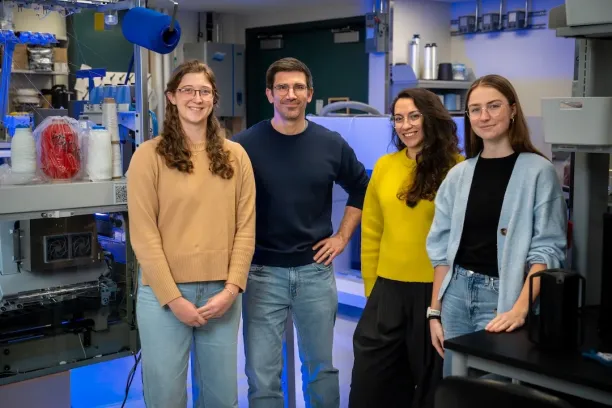
Rice University professors Daniel J. Preston and Vanessa Sanchez, both in the Department of Mechanical Engineering, are core partners in the six-year initiative led by the University of Alberta. The collaboration aims to develop assistive garments that feel and look like normal clothing, while quietly providing support such as posture assistance, balance stabilisation and help with sit-to-stand movement.
Sanchez brings expertise in fibre science, materials engineering and robotics, with a focus on textile-native manufacturing methods for wearable robotic technologies. Her team at texlab develops smart fibres and flat knitted and woven structures that can actuate, sense and route power and data within garments, enabling designs intended to fit diverse body types and movement patterns.
The challenge is to make the assistance we provide feel as natural as fabric itself — responsive but unobtrusive and almost imperceptible
“Our goal is to create clothing that looks and feels like what people already love to wear,” said Sanchez. “If we can embed intelligence and comfort into everyday garments, we can change how people experience mobility assistance.”
Preston’s laboratory contributes knowledge in control systems and power for compliant devices, with a strong emphasis on reliability and comfort. The work includes embedded logic and local computation to improve privacy and reduce power demand, alongside practical requirements such as washability and day-long wear.
“The challenge is to make the assistance we provide feel as natural as fabric itself — responsive but unobtrusive and almost imperceptible,” Preston said. “We want these garments to move with people, not on them.”
The consortium is targeting a significant unmet need. While billions of people could benefit from rehabilitation support or mobility assistance, many cannot access or tolerate current technologies. Conventional braces can be bulky and non-adaptive, powered exoskeletons are costly and rigid, and most smart garments on the market today focus on monitoring rather than providing active assistance.
By integrating sensing and actuation directly into fibres and textile structures, the team aims to create assistive clothing that is lightweight, washable, attractive, affordable and scalable. Rice University will support the programme through doctoral trainees over the full project duration, with additional undergraduate and master’s student involvement through collaborations in design, biomechanics and healthcare across the Texas Medical Center.
In the near term, the Rice teams will fabricate and test fibre-level actuators and durable sensors compatible with standard knitting and weaving processes. They will also develop control prototypes that keep computation on the garment itself for improved efficiency and privacy. Fit and patterning studies will run in parallel to ensure comfort across different sizes, genders and mobility profiles, supported by clinician partnerships for biomechanics testing, usability trials and feedback on real-world performance.
The wider programme aims to create garments in which the fibres themselves perform the work - changing stiffness, applying gentle forces and sensing motion without bulky add-ons. Its development plan includes three escalating use cases shaped by end-user workshops: posture support for caregivers and older adults; smart sleeves that assist arm movement during daily tasks; and leggings or shorts that improve balance, gait and sit-to-stand transitions.
Key technologies under investigation include electrostatic actuators miniaturised into fibres for safe low-voltage assistance, textile-embedded EMG and strain sensors to detect user intent, and on-garment control systems that combine rapid stabilisation with machine learning-based personalisation, supported by safety-first fallback features.
A central feature of the CAD $24 million award is its co-design framework, involving people with lived experience of mobility limitations throughout the project. Clinicians, industrial partners and artists will also contribute to iterative cycles of prototyping and evaluation. Midway and end-of-project public art-and-technology festivals are planned to showcase progress and gather wider input on inclusive design.
Preston and Sanchez travelled to Alberta in 2025 for the project kickoff alongside their graduate students. Over the course of the award, Rice students will have opportunities to rotate through partner laboratories, while Rice will host visiting researchers from the University of Alberta and other institutions, strengthening talent development at the intersection of materials, apparel engineering and human-machine interaction.

Business intelligence for the fibre, textiles and apparel industries: technologies, innovations, markets, investments, trade policy, sourcing, strategy...
Find out more